Before you buy a used Skoda Karoq.
Taken only from Testigo's sourced sheets. Use it to question the seller and on the test drive: it does not confirm that any particular car is affected.
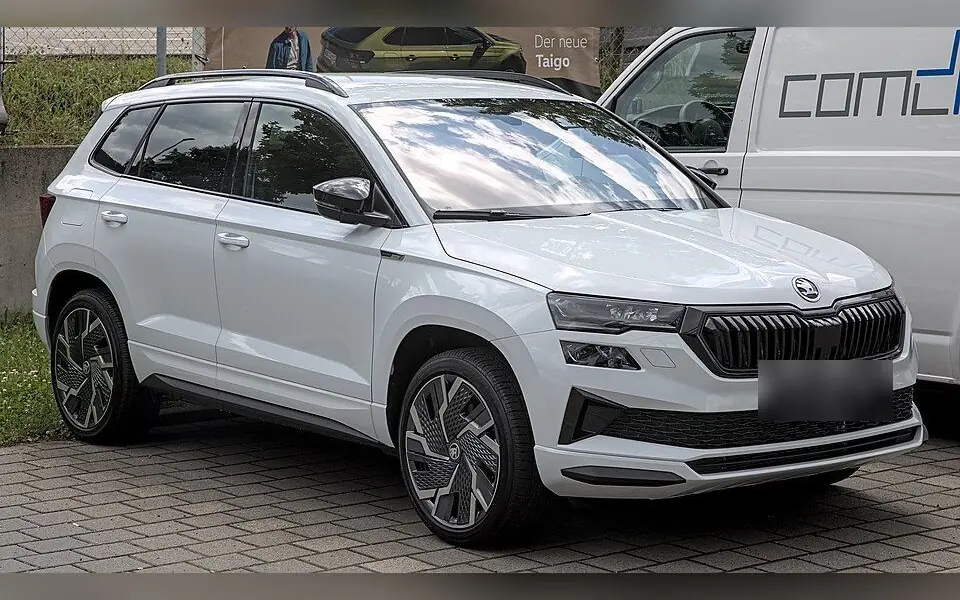
The essentials.
- 8 documented, sourced faults across its 4 engines.
- 5 of them depend on the equipment or the production date: ask what this car has.
- 2 official recalls on record: ask for the chassis number (VIN) and confirm they have been done.
- According to the data we have, the engines with the fewest documented faults are: 1.0 / 1.5 TSI (Petrol), 2.0 TSI (Petrol).
Typical faults by engine
The period and mileage are those mentioned by each sheet's sources. They are not a maintenance interval and do not predict that any particular car will fail.
All versions
Sheets the catalogue links to all 4 of its engines.
- A/C not cooling: N280 valveClimate control
- Period mentioned
- 2006–2026
- Mileage mentioned
- The sheet does not mention a mileage.
Applies if: Only if fitted with the air conditioning system described.
- Unstable rear camera, SmartLink or Bluetooth on recent Škoda Fabia, Scala, Kamiq, Karoq, Kodiaq and SuperbElectrical and electronic systems
- Period mentioned
- Recent generations (the brand gives no years)
- Mileage mentioned
- The sheet does not mention a mileage.
Applies if: Confirm with Škoda, using the VIN, whether the campaign applies to your car.
1.0 / 1.5 TSI
Petrol
- 1.5 TSI evo cold jerkingEngine management
- Period mentioned
- 2017–2022
- Mileage mentioned
- The sheet does not mention a mileage.
- Period mentioned
- 2008 onwards
- Mileage mentioned
- The sheet does not mention a mileage.
Applies if: Only if fitted with the 7-speed DQ200 DSG. Confirm the gearbox type.
2.0 TSI
Petrol
- Period mentioned
- 2012–2020
- Mileage mentioned
- Up to 100,000 km
- DQ250 DSG mechatronic and oilDSG gearbox
- Period mentioned
- 2003–2020
- Mileage mentioned
- From 60,000 km
Applies if: Only if fitted with the 6-speed DQ250 DSG. Confirm the gearbox type.
1.6 TDI (EA288)
Diesel
- Cracked EGR coolerCooling / EGR
- Period mentioned
- Approx. 2010–2020
- Mileage mentioned
- The sheet does not mention a mileage.
- Cracked water-cooled intercooler on the 1.6 and 2.0 TDI EA288: coolant loss with no external leakCooling
- Period mentioned
- All EA288 years
- Mileage mentioned
- The sheet does not mention a mileage.
Applies if: Transverse EA288 engines with the water-cooled intercooler inside the intake manifold (the garage confirms it).
These also apply, described above: DSG7 gearbox mechatronic unit (DQ200)
2.0 TDI (EA288)
Diesel
These also apply, described above: Cracked EGR cooler · DQ250 DSG mechatronic and oil · Cracked water-cooled intercooler on the 1.6 and 2.0 TDI EA288: coolant loss with no external leak
Which engine has the fewest documented faults?
| Engine | Documented faults | Recalls |
|---|---|---|
| 1.0 / 1.5 TSIPetrolFewest documented | 43 with conditions | 2 |
| 2.0 TSIPetrolFewest documented | 43 with conditions | 2 |
| 1.6 TDI (EA288)Diesel | 54 with conditions | 2 |
| 2.0 TDI (EA288)Diesel | 54 with conditions | 2 |
According to the data we have, the engines with the fewest documented faults are: 1.0 / 1.5 TSI (Petrol), 2.0 TSI (Petrol).
By fuel, all versions have the same number of documented faults.
We only count the sourced sheets we have. An engine with fewer is not guaranteed to be more reliable: it may have been studied less or sold in smaller numbers.
Official recalls: ask before you pay
A recall existing does not mean this car is affected or that it is still outstanding: it depends on the chassis number, the market and the production date.
- Ask the seller for the chassis number (VIN): it has 17 characters, appears in the car's documents and can usually also be seen at the base of the windscreen.
- Ask an official Skoda dealer, or the brand's official website if it lets you check by chassis number, whether each recall has been done or is still outstanding for that VIN.
- Manufacturer recalls are normally carried out free of charge by the official service network. If one is outstanding, ask for it to be done before you close the sale.
Steering rack bolt that corrodes and may break (recall 48LS: Octavia, Superb, Karoq and Kodiaq)Steering
How to check it: Ask a Škoda dealer, with the VIN, whether your car has recall 48LS outstanding: they check the mounting and fit a more corrosion-resistant bolt, free of charge. If you notice noises when turning, play in the wheel or stiff steering, stop somewhere safe and call the dealer or breakdown assistance before driving on.
View full entryPoorly welded brake pedal plate that may bend or come off under hard braking (automatic Karoq and Kodiaq of 2020)Brakes
How to check it: Ask a Škoda dealer, with the VIN, whether your car has this recall outstanding: they check the weld and, if it is faulty, replace the brake pedal. If the pedal feels loose, bent or moves sideways, do not drive on.
View full entryOn the test drive: what to look and listen for
Taken from each sheet's symptoms and checks. You can tick off what you have already looked at: it is saved only in this browser.
0 of 8 checked
Engine management
Look out for: Rhythmic jerking (“kangaroo effect”) and hesitation when accelerating at roughly 1,200–2,000 rpm, with a cold engine and in low gears; most noticeable with a manual gearbox.
Ask them to check: Test the car from cold in first and second gear, and check at the dealer whether the latest engine control unit software is installed.
Cooling
Look out for: Slow coolant loss, sweet smell, low-coolant warning and coolant residue under the intake manifold. Overheating is rare unless the level drops a lot.
Ask them to check: Look for coolant residue where the module meets the block and between pump and thermostat, check the level and pressure-test the system.
Look out for: The coolant level drops and needs frequent topping up, but there is no visible stain or drip outside; there may be some white smoke. A clue: a greasy oil-and-water paste on the block next to cylinder 4, near the bulkhead.
Ask them to check: The garage can check it before removing the manifold: take out the intake air temperature sensor, insert an endoscope camera through its hole, pressurise the cooling circuit and look at the intercooler's inner fins. Have them also rule out the EGR cooler and the head gasket, which give similar symptoms.
Cooling / EGR
Look out for: Coolant level drops with no visible leak, white smoke with a sweet smell, rising temperature or engine light. In severe cases the engine hydrolocks.
Ask them to check: Cooling system pressure test and check for coolant in the intake or manifold.
Gearbox
Look out for: Judder or shudder pulling away in 1st/2nd, reverse won't engage, PRNDS letters flashing or a spanner warning, gearbox stuck in one gear (limp mode).
Ask them to check: Read the gearbox module faults with VCDS, OBDeleven or similar and check the mechatronic fuse.
Climate control
Look out for: The air does not cool or cools intermittently (for example only at motorway speed), and sometimes the compressor rattles with the A/C on. Codes 01232 (N280 valve), P2612 or 00898.
Ask them to check: Read the codes and N280 control current with VCDS or ODIS, measure its resistance (about 10 ohms) and check the connector and wiring before replacing parts. If the valve or compressor is replaced, the whole circuit must be flushed.
Electrical and electronic systems
Look out for: The reversing camera image is slow to appear, cuts out or does not show; Android Auto, Apple CarPlay or Bluetooth disconnect; the connected services fail.
Ask them to check: Ask Škoda, with the VIN, whether any of these campaigns applies to the car and whether it still needs installing. If the camera keeps failing with up-to-date software, check the camera, its connector and its wiring.
DSG gearbox
Look out for: Jerking or shudder when pulling away and at low speed, harsh shifts, gearbox warning or limp mode; codes P17BF, P189C, P0841, P0871 or P0717.
Ask them to check: Read codes with ODIS or VCDS, check the oil change history, inspect the pan for rust or leaks and the clutch adaptation values. Replacing the mechatronic control board is often enough.
Sources
Every fact on this page comes from these Testigo sheets and their original sources. Sources are not checked in real time.
- 1.5 TSI evo cold jerking
- EA888 gen 3 water pump and thermostat
- Cracked EGR cooler
- DSG7 gearbox mechatronic unit (DQ200)
- A/C not cooling: N280 valve
- Unstable rear camera, SmartLink or Bluetooth on recent Škoda Fabia, Scala, Kamiq, Karoq, Kodiaq and Superb
- DQ250 DSG mechatronic and oil
- Cracked water-cooled intercooler on the 1.6 and 2.0 TDI EA288: coolant loss with no external leak
- Steering rack bolt that corrodes and may break (recall 48LS: Octavia, Superb, Karoq and Kodiaq)
- Poorly welded brake pedal plate that may bend or come off under hard braking (automatic Karoq and Kodiaq of 2020)
More Skoda buying guides
- Skoda Scala2019–2026
- Skoda Kamiq2019–2026
- Skoda Octavia IV2020–2026
- Skoda Kodiaq2016–2024
- Skoda Fabia IV2021–2026
- Skoda Superb III (3V)2015–2024
- Skoda Enyaq / Elroq2021–2026
- Skoda Kodiaq II / Superb IV2024–2026