Before you buy a used Alfa Romeo 156.
Taken only from Testigo's sourced sheets. Use it to question the seller and on the test drive: it does not confirm that any particular car is affected.
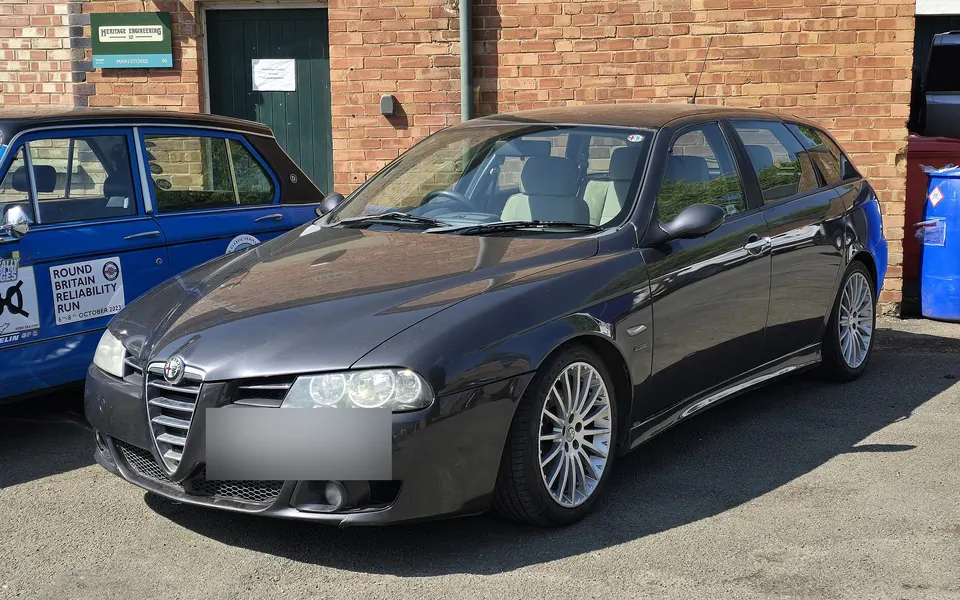
The essentials.
- 2 documented, sourced faults across its 2 engines.
- That is not much data: if no other faults show up here, it does not mean it has none.
- 1 official recall on record: ask for the chassis number (VIN) and confirm it has been done.
- According to the data we have, all its engines have the same number of documented faults.
Typical faults by engine
The period and mileage are those mentioned by each sheet's sources. They are not a maintenance interval and do not predict that any particular car will fail.
1.6 / 1.8 / 2.0 TS
Petrol
- Period mentioned
- Approx. 1997–2010
- Mileage mentioned
- What the sheet says: The phaser that adjusts the camshaft wears; on early engines the piston design encouraged oil consumption (changed later). Owners recommend changing the belt every 5 years or 60,000 km.
1.9 / 2.4 JTD
Diesel
- 1.9/2.4 JTD intake flaps, EGR and flywheelIntake / EGR / flywheel
- Period mentioned
- 1997–2012
- Mileage mentioned
- 80,000–150,000 km
Which engine has the fewest documented faults?
| Engine | Documented faults | Recalls |
|---|---|---|
| 1.6 / 1.8 / 2.0 TSPetrol | 1 | 1 |
| 1.9 / 2.4 JTDDiesel | 1 | 0 |
According to the data we have, all its engines have the same number of documented faults.
We only count the sourced sheets we have. An engine with fewer is not guaranteed to be more reliable: it may have been studied less or sold in smaller numbers.
Official recalls: ask before you pay
A recall existing does not mean this car is affected or that it is still outstanding: it depends on the chassis number, the market and the production date.
- Ask the seller for the chassis number (VIN): it has 17 characters, appears in the car's documents and can usually also be seen at the base of the windscreen.
- Ask an official Alfa Romeo dealer, or the brand's official website if it lets you check by chassis number, whether each recall has been done or is still outstanding for that VIN.
- Manufacturer recalls are normally carried out free of charge by the official service network. If one is outstanding, ask for it to be done before you close the sale.
Front suspension plate fasteningSuspension
Engines: 1.6 / 1.8 / 2.0 TS (Petrol)
How to check it: Confirm recall; replace plates and fasteners with modified parts.
View full entryOn the test drive: what to look and listen for
Taken from each sheet's symptoms and checks. You can tick off what you have already looked at: it is saved only in this browser.
0 of 2 checked
Engine
Look out for: A diesel-like clatter at idle after a cold start and less power (cam phaser); high oil consumption; with an overdue belt, a risk of serious failure.
Ask them to check: Listen on a cold start; measure oil consumption (over 300 ml per 1,000 km is abnormal); check when the belt and phaser were changed.
Intake / EGR / flywheel
Look out for: Power loss, rough idle and an engine light with “swirl actuator malfunction”; soot around the intake manifold; vibration and knocks in low gears (dual-mass flywheel).
Ask them to check: Check the rod and flap operation on top of the manifold, read actuator codes, inspect the EGR and listen to the flywheel when starting and stopping.
Sources
Every fact on this page comes from these Testigo sheets and their original sources. Sources are not checked in real time.
More Alfa Romeo buying guides
- Alfa Romeo GTV / Spider (916)2000–2005
- Alfa Romeo 1662000–2007
- Alfa Romeo 145 / 1462000–2001
- Alfa Romeo 1472000–2010
- Alfa Romeo GT2003–2010
- Alfa Romeo Brera / Spider2005–2010
- Alfa Romeo 1592005–2011
- Alfa Romeo MiTo2008–2018