Before you buy a used Renault Laguna (II).
Taken only from Testigo's sourced sheets. Use it to question the seller and on the test drive: it does not confirm that any particular car is affected.
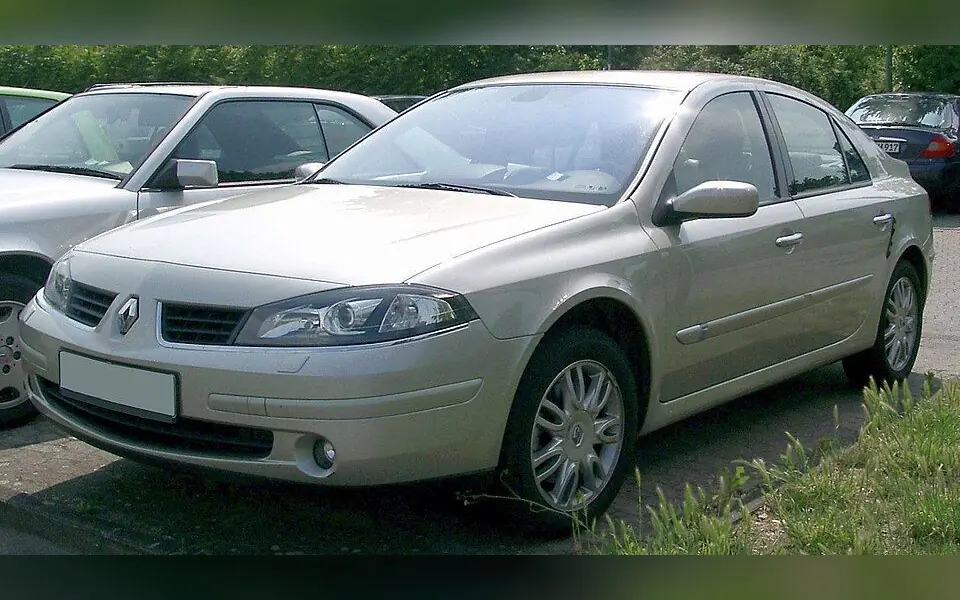
The essentials.
- 2 documented, sourced faults across its 5 engines.
- That is not much data: if no other faults show up here, it does not mean it has none.
- They all depend on the equipment or the production date: ask what this car has.
- 4 official recalls on record: ask for the chassis number (VIN) and confirm they have been done.
- According to the data we have, all its engines have the same number of documented faults.
Typical faults by engine
The period and mileage are those mentioned by each sheet's sources. They are not a maintenance interval and do not predict that any particular car will fail.
All versions
Sheets the catalogue links to all 5 of its engines.
- Period mentioned
- 2001–2007
- Mileage mentioned
- What the sheet says: The hands-free card is its biggest weak point. Front-axle parts (links, ball joints, arms and bushes) are under-engineered. Auto Bild mentions an undersized clutch that may need replacing before 50,000 km (about €950).
Applies if: Second-generation Laguna.
- “Card not detected”: the car does not recognise the key cardElectrical and electronic systems
- Period mentioned
- Approx. 2003–2009
- Mileage mentioned
- The sheet does not mention a mileage.
Applies if: The Laguna II uses the same hands-free card; the German guide calls it its biggest weak point.
1.6 / 1.8 / 2.0 16V (K4M / F4P / F4R) · 2.0 Turbo (F4Rt) · 3.0 V6 · 1.9 dCi (F9Q) · 2.2 dCi (G9T)
1.6 / 1.8 / 2.0 16V (K4M / F4P / F4R) (Petrol) · 2.0 Turbo (F4Rt) (Petrol) · 3.0 V6 (Petrol) · 1.9 dCi (F9Q) (Diesel) · 2.2 dCi (G9T) (Diesel)
We have no faults specific to this engine, only those common to every version.
Which engine has the fewest documented faults?
| Engine | Documented faults | Recalls |
|---|---|---|
| 1.6 / 1.8 / 2.0 16V (K4M / F4P / F4R)Petrol | 22 with conditions | 4 |
| 2.0 Turbo (F4Rt)Petrol | 22 with conditions | 4 |
| 3.0 V6Petrol | 22 with conditions | 4 |
| 1.9 dCi (F9Q)Diesel | 22 with conditions | 4 |
| 2.2 dCi (G9T)Diesel | 22 with conditions | 4 |
According to the data we have, all its engines have the same number of documented faults.
We only count the sourced sheets we have. An engine with fewer is not guaranteed to be more reliable: it may have been studied less or sold in smaller numbers.
Official recalls: ask before you pay
A recall existing does not mean this car is affected or that it is still outstanding: it depends on the chassis number, the market and the production date.
- Ask the seller for the chassis number (VIN): it has 17 characters, appears in the car's documents and can usually also be seen at the base of the windscreen.
- Ask an official Renault dealer, or the brand's official website if it lets you check by chassis number, whether each recall has been done or is still outstanding for that VIN.
- Manufacturer recalls are normally carried out free of charge by the official service network. If one is outstanding, ask for it to be done before you close the sale.
Renault brake recalls (2000–2014)Brakes
How to check it: Check the recall by VIN; inspect and replace, reprogram or correct the part named in the recall.
View full entryRenault engine, injection and accelerator recalls (2001–2013)Powertrain and engine management
How to check it: Check the recall by VIN; inspect and replace, reprogram or correct the part named in the recall.
View full entryRenault fuel-leak recalls (2001–2013)Fuel system
How to check it: Check the recall by VIN; with a fuel smell, do not drive; reposition, tighten or replace the pipes named.
View full entryOther Renault recalls: tyres, body, gearbox and electrics (2000–2014)Bodywork
How to check it: Check the recall by VIN; inspect and replace, reprogram or correct the part named in the recall.
View full entryOn the test drive: what to look and listen for
Taken from each sheet's symptoms and checks. You can tick off what you have already looked at: it is saved only in this browser.
0 of 2 checked
Known weak points
Look out for: The car will not open or start (card, reader or start button); false tyre-pressure warnings; front-axle play; on diesels, turbo failure; a clutch that wears out before 50,000 km; rust on load-bearing parts.
Ask them to check: Test the card and start-up several times; check play and rust; on diesels, check for turbo whistle and smoke.
Electrical and electronic systems
Look out for: The cards stop opening or starting the car, hands-free and with the buttons, and “Card not detected” appears; sometimes it clears by itself after a few minutes.
Ask them to check: Try the other card and its battery; at the dealer or with a diagnostic tool, check the UCH and relearn both cards.
Sources
Every fact on this page comes from these Testigo sheets and their original sources. Sources are not checked in real time.
- Card, pressure sensors, front suspension, turbo and clutch on the Laguna II
- “Card not detected”: the car does not recognise the key card
- Renault brake recalls (2000–2014)
- Renault engine, injection and accelerator recalls (2001–2013)
- Renault fuel-leak recalls (2001–2013)
- Other Renault recalls: tyres, body, gearbox and electrics (2000–2014)
More Renault buying guides
- Renault Kangoo (I)2000–2008
- Renault Twingo (I)2000–2007
- Renault Master (II)2000–2010
- Renault Mégane (II)2002–2009
- Renault Clio (II) / Clio Campus2000–2012
- Renault Scénic (II) / Grand Scénic (II)2003–2009
- Renault Scénic (I)2000–2003
- Renault Mégane (I)2000–2002