Before you buy a used Renault Scénic (IV) / Grand Scénic (IV).
Taken only from Testigo's sourced sheets. Use it to question the seller and on the test drive: it does not confirm that any particular car is affected.
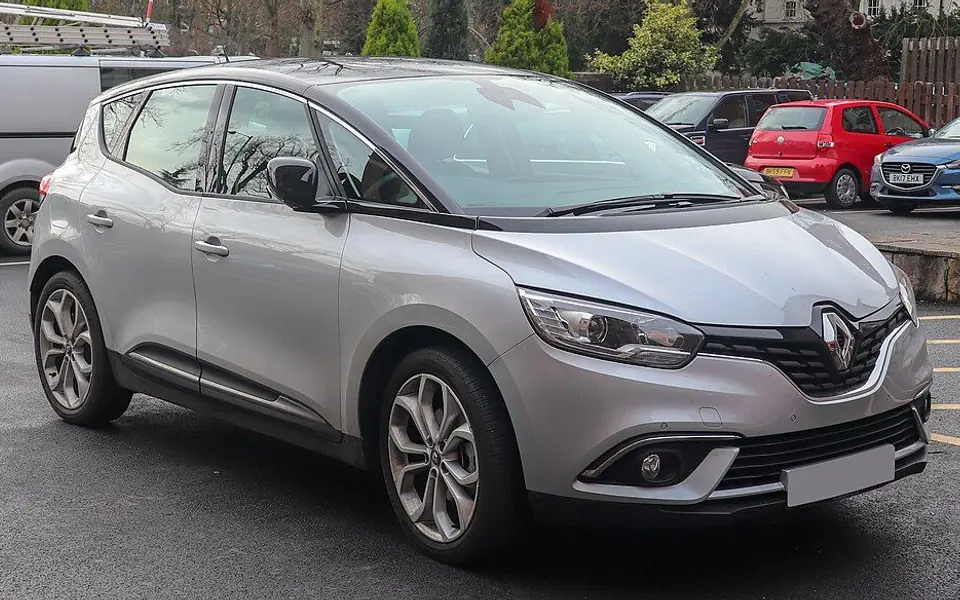
The essentials.
- 5 documented, sourced faults across its 5 engines.
- 3 of them depend on the equipment or the production date: ask what this car has.
- 5 official recalls on record: ask for the chassis number (VIN) and confirm they have been done.
- According to the data we have, the engines with the fewest documented faults are: 1.3 TCe (H5Ht) (Petrol), 1.6 dCi (R9M) (Diesel), 1.7 Blue dCi (R9N) (Diesel).
Typical faults by engine
The period and mileage are those mentioned by each sheet's sources. They are not a maintenance interval and do not predict that any particular car will fail.
All versions
Sheets the catalogue links to all 5 of its engines.
- Suspension, oil leaks and campaigns on the Scénic IVKnown weak points
- Period mentioned
- 2016–2022
- Mileage mentioned
- What the sheet says: Suspension defects well above average at the first roadworthiness test, lights, misaligned doors and interior rattles, engine and gearbox oil leaks after a few years and timing chains that may need replacing before 100,000 km.
Applies if: Weak points of this model from inspections, breakdown statistics and recalls; anything specific to one engine is stated in the sheet.
1.2 TCe (H5Ft)
Petrol
- Stretched timing chain on the 0.9 and 1.2 TCeValve timing
- Period mentioned
- Approx. 2012–2020
- Mileage mentioned
- The sheet does not mention a mileage.
1.3 TCe (H5Ht) · 1.6 dCi (R9M) · 1.7 Blue dCi (R9N)
1.3 TCe (H5Ht) (Petrol) · 1.6 dCi (R9M) (Diesel) · 1.7 Blue dCi (R9N) (Diesel)
We have no faults specific to this engine, only those common to every version.
1.5 dCi / Blue dCi (K9K)
Diesel
- Clogged particulate filter on the 1.5 dCiExhaust and emissions
- Period mentioned
- 2010 onwards
- Mileage mentioned
- The sheet does not mention a mileage.
- EGR valve sticking with deposits on the 1.5 dCiExhaust and emissions
- Period mentioned
- No specific period published
- Mileage mentioned
- The sheet does not mention a mileage.
Applies if: The Blue dCi has another EGR system: the sheet is for the 1.5 dCi with an electric EGR valve.
- Period mentioned
- No specific period published
- Mileage mentioned
- The sheet does not mention a mileage.
Applies if: Only if the injection pump is a Delphi (it says so on the pump): depending on the version, the 1.5 dCi has Delphi or Siemens/Continental.
Which engine has the fewest documented faults?
| Engine | Documented faults | Recalls |
|---|---|---|
| 1.2 TCe (H5Ft)Petrol | 21 with conditions | 5 |
| 1.3 TCe (H5Ht)PetrolFewest documented | 11 with conditions | 5 |
| 1.5 dCi / Blue dCi (K9K)Diesel | 43 with conditions | 5 |
| 1.6 dCi (R9M)DieselFewest documented | 11 with conditions | 5 |
| 1.7 Blue dCi (R9N)DieselFewest documented | 11 with conditions | 5 |
According to the data we have, the engines with the fewest documented faults are: 1.3 TCe (H5Ht) (Petrol), 1.6 dCi (R9M) (Diesel), 1.7 Blue dCi (R9N) (Diesel).
By fuel type, the one with the fewest documented faults is: Petrol.
We only count the sourced sheets we have. An engine with fewer is not guaranteed to be more reliable: it may have been studied less or sold in smaller numbers.
Official recalls: ask before you pay
A recall existing does not mean this car is affected or that it is still outstanding: it depends on the chassis number, the market and the production date.
- Ask the seller for the chassis number (VIN): it has 17 characters, appears in the car's documents and can usually also be seen at the base of the windscreen.
- Ask an official Renault dealer, or the brand's official website if it lets you check by chassis number, whether each recall has been done or is still outstanding for that VIN.
- Manufacturer recalls are normally carried out free of charge by the official service network. If one is outstanding, ask for it to be done before you close the sale.
Renault brake recalls (2015–2021)Brakes
How to check it: Check the recall by VIN; inspect and replace the part named in the recall. With a brake fault, do not drive.
View full entryRenault airbag recalls (2016–2024)Airbags and seat belts
How to check it: Check the recall by VIN; carry out the inspection, reprogramming or replacement it requires.
View full entryRenault recalls for fuel-leak risk (2015–2024)Fuel system
How to check it: Check the recall by VIN; with a fuel smell, do not drive and have the circuit checked; protect or replace the part named.
View full entryRenault engine, emissions and software recalls (2015–2025)Powertrain and engine management
How to check it: Check the recall by VIN; carry out the reprogramming or replacement it requires.
View full entryRenault seat and child-lock recalls (2015–2024)Passive safety / seats
How to check it: Check the recall by VIN; inspect and reinforce or replace the part named; check the child lock stays on.
View full entryOn the test drive: what to look and listen for
Taken from each sheet's symptoms and checks. You can tick off what you have already looked at: it is saved only in this browser.
0 of 5 checked
Valve timing
Look out for: Metallic chain rattle, especially when cold or at idle; engine light with a crankshaft–camshaft correlation code; in serious cases the chain jumps and damages the valves.
Ask them to check: With any chain noise or a P0016 code, diagnose straight away: measure the stretch and check the tensioner and guides before the timing jumps. Shorten oil-change intervals.
Exhaust and emissions
Look out for: Particulate-filter or emissions warning, limp mode with loss of power and frequent regenerations.
Ask them to check: Read the soot load with a diagnostic tool, run a forced regeneration at the garage and check the differential-pressure sensors and EGR. Make long road trips now and then.
Look out for: Uneven idle, jerks when accelerating, lack of power or the engine going into limp mode, sometimes with the engine warning light on.
Ask them to check: At the workshop: read the codes with diagnostic equipment (EOBD P0400 to P0404 or P0172; Renault DF077, DF084 or DF241), test the valve electrically and its opening with the engine warm, and find where the oil comes from (breather, turbo, level). Pierburg advises against cleaning it, as it can be damaged: it is replaced if faulty, and an engine ECU update sometimes solves it.
Known weak points
Look out for: Suspension defects well above average at the first roadworthiness test, lights, misaligned doors and interior rattles, engine and gearbox oil leaks after a few years and timing chains that may need replacing before 100,000 km.
Ask them to check: Check every campaign by VIN; check the suspension, oil leaks and chain noise when cold.
Inyección
Look out for: Hard to start or will not start, stalls, loses power or jerks; sometimes air bubbles show in the clear fuel pipe.
Ask them to check: At the workshop, in this order: look for air and leaks in the low-pressure circuit and prime it; check the fuel filter bowl for metal swarf (if there is any, the whole injection system is replaced); measure the rail pressure, the IMV regulator's resistance (4.8–5.8 Ω) and each injector's return flow (25 ml at most in the test). A new injector's code must be written into the ECU.
Sources
Every fact on this page comes from these Testigo sheets and their original sources. Sources are not checked in real time.
- Stretched timing chain on the 0.9 and 1.2 TCe
- Clogged particulate filter on the 1.5 dCi
- Suspension, oil leaks and campaigns on the Scénic IV
- EGR valve sticking with deposits on the 1.5 dCi
- Delphi injection on the 1.5 dCi: air in the fuel, metal swarf, regulator or injectors
- Renault brake recalls (2015–2021)
- Renault airbag recalls (2016–2024)
- Renault recalls for fuel-leak risk (2015–2024)
- Renault engine, emissions and software recalls (2015–2025)
- Renault seat and child-lock recalls (2015–2024)
More Renault buying guides
- Renault Twingo (III)2014–2024
- Renault Espace (V)2015–2023
- Renault Mégane (IV)2016–2023
- Renault Kadjar2015–2022
- Renault Koleos (II)2016–2023
- Renault Talisman2015–2022
- Renault Zoe2012–2024
- Renault Trafic (III)2014–2026