Before you buy a used Audi A4 (B7).
Taken only from Testigo's sourced sheets. Use it to question the seller and on the test drive: it does not confirm that any particular car is affected.
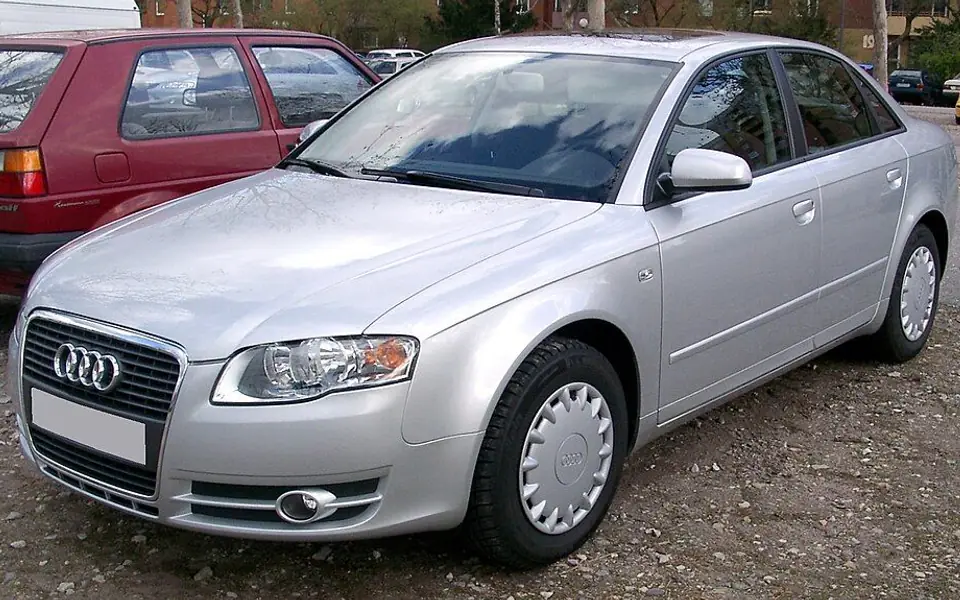
The essentials.
- 6 documented, sourced faults across its 5 engines.
- 2 of them depend on the equipment or the production date: ask what this car has.
- We have no official recalls on record for this model; ask anyway, with the chassis number (VIN).
- According to the data we have, all its engines have the same number of documented faults.
Typical faults by engine
The period and mileage are those mentioned by each sheet's sources. They are not a maintenance interval and do not predict that any particular car will fail.
All versions
Sheets the catalogue links to all 5 of its engines.
- A/C not cooling: N280 valveClimate control
- Period mentioned
- 2006–2026
- Mileage mentioned
- The sheet does not mention a mileage.
Applies if: Only if fitted with the air conditioning system described.
- Audi Multitronic (CVT) gearboxAutomatic gearbox
- Period mentioned
- 2000–2014
- Mileage mentioned
- The sheet does not mention a mileage.
Applies if: Only if fitted with the automatic gearbox described in the record.
1.8 T / 2.0 TFSI
Petrol
- 2.0 TFSI EA113 high-pressure pump followerInjection / high-pressure pump
- Period mentioned
- 2004–2013
- Mileage mentioned
- From 90,000 km
1.9 / 2.0 TDI PD
Diesel
- PD TDI camshaft, injectors and cylinder headInjection / cylinder head
- Period mentioned
- 2000–2010
- Mileage mentioned
- 120,000–200,000 km
2.7 / 3.0 TDI V6
Diesel
- V6 TDI rear chains, intake flaps and leaksTiming / intake / leaks
- Period mentioned
- 2004–2018
- Mileage mentioned
- 100,000–150,000 km
S4 (4.2 V8) · RS4 (4.2 FSI V8)
Petrol
- 4.2 V8 rear chains and carbon build-upTiming / intake
- Period mentioned
- 2003–2015
- Mileage mentioned
- From 40,000 km
Which engine has the fewest documented faults?
| Engine | Documented faults |
|---|---|
| 1.8 T / 2.0 TFSIPetrol | 32 with conditions |
| 1.9 / 2.0 TDI PDDiesel | 32 with conditions |
| 2.7 / 3.0 TDI V6Diesel | 32 with conditions |
| S4 (4.2 V8)Petrol | 32 with conditions |
| RS4 (4.2 FSI V8)Petrol | 32 with conditions |
According to the data we have, all its engines have the same number of documented faults.
We only count the sourced sheets we have. An engine with fewer is not guaranteed to be more reliable: it may have been studied less or sold in smaller numbers.
Official recalls: ask before you pay
We have no official recalls on record for this model. Our list is not complete: ask anyway, with the chassis number.
- Ask the seller for the chassis number (VIN): it has 17 characters, appears in the car's documents and can usually also be seen at the base of the windscreen.
- Ask an official Audi dealer, or the brand's official website if it lets you check by chassis number, whether each recall has been done or is still outstanding for that VIN.
- Manufacturer recalls are normally carried out free of charge by the official service network. If one is outstanding, ask for it to be done before you close the sale.
On the test drive: what to look and listen for
Taken from each sheet's symptoms and checks. You can tick off what you have already looked at: it is saved only in this browser.
0 of 6 checked
Injection / high-pressure pump
Look out for: Power loss or hesitation at full load, fuel pressure codes, high-pressure pump noise; fuel smell in the oil and a rising level if the pump leaks; misfires.
Ask them to check: Check the high-pressure pump follower at every service, smell the oil and watch its level, and read fuel pressure with a diagnostic tool.
Injection / cylinder head
Look out for: Growing noise from the cylinder head, power loss and rough running (cams and lifters); unstable idle, smoke or hesitation (injectors); on the 16-valve 2.0 TDI, coolant loss with no visible leak from a cracked head.
Ask them to check: Check the oil history (VW 505.01), listen to the head, check injector balance rates with a diagnostic tool and, on the 16-valve 2.0 TDI, read the head part number (03G 103 351) and look for coolant loss.
Timing / intake / leaks
Look out for: Chain rattle for the first seconds after a cold start; power loss or limp mode from the intake flaps; coolant or oil loss in the engine V; EGR faults with rough idle.
Ask them to check: Listen to a cold start (a rattle lasting more than 2–3 seconds is a bad sign), check flap operation with a diagnostic tool, look for leaks in the engine V and check the oil change history.
Timing / intake
Look out for: Rattle from the rear of the engine on a cold start, misfires or an engine light for timing deviation; on FSI engines, power loss and rough idle from carbon build-up.
Ask them to check: Listen to a cold start, read crank-cam correlation codes and inspect the intake valves with a borescope.
Climate control
Look out for: The air does not cool or cools intermittently (for example only at motorway speed), and sometimes the compressor rattles with the A/C on. Codes 01232 (N280 valve), P2612 or 00898.
Ask them to check: Read the codes and N280 control current with VCDS or ODIS, measure its resistance (about 10 ohms) and check the connector and wiring before replacing parts. If the valve or compressor is replaced, the whole circuit must be flushed.
Automatic gearbox
Look out for: Judder or vibration when pulling away (especially uphill), a slipping feeling at low revs, jerky acceleration and limp mode with limited speed; sometimes a burning smell.
Ask them to check: Read the gearbox codes with Audi-compatible equipment, check the fluid change history and, at a specialist, judge whether fluid and a clutch adaptation are enough or the control unit or variator needs repair. With limp mode or a burning smell, stop driving.
Sources
Every fact on this page comes from these Testigo sheets and their original sources. Sources are not checked in real time.
More Audi buying guides
- Audi A3 (8P)2003–2012
- Audi A6 (C6)2004–2011
- Audi TT (8N)2000–2006
- Audi A22000–2005
- Audi A4 (B6)2000–2004
- Audi A6 (C5)2000–2004
- Audi TT (8J)2006–2014
- Audi A3 (8L)2000–2003