Before you buy a used Jeep Grand Cherokee (WK2).
Taken only from Testigo's sourced sheets. Use it to question the seller and on the test drive: it does not confirm that any particular car is affected.
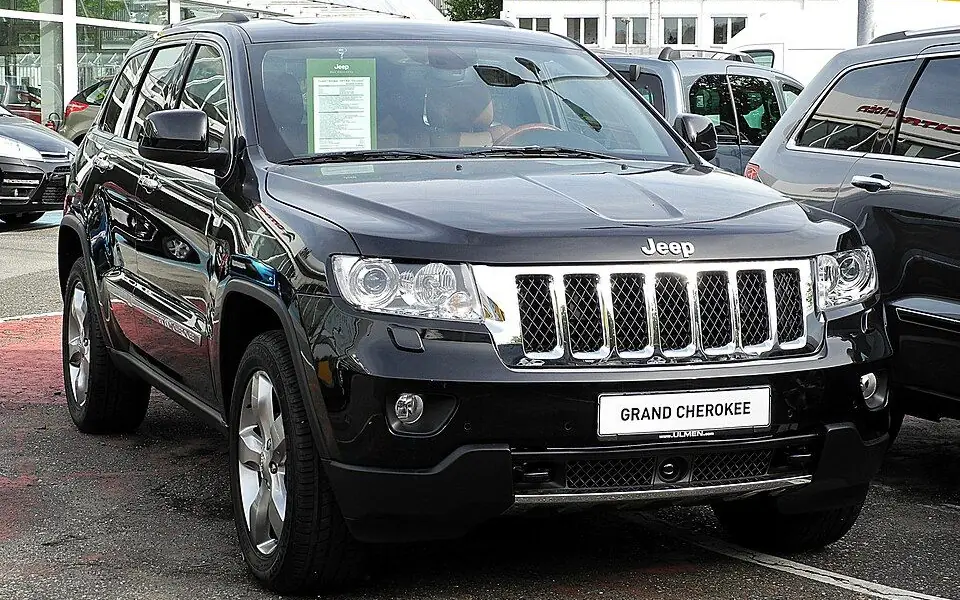
The essentials.
- 4 documented, sourced faults across its 2 engines.
- 2 of them depend on the equipment or the production date: ask what this car has.
- 10 official recalls on record: ask for the chassis number (VIN) and confirm they have been done.
- According to the data we have, the engine with the fewest documented faults is the 3.6 V6 (Petrol).
Typical faults by engine
The period and mileage are those mentioned by each sheet's sources. They are not a maintenance interval and do not predict that any particular car will fail.
All versions
Sheets the catalogue links to all 2 of its engines.
- Period mentioned
- 2011–2021
- Mileage mentioned
- What the sheet says: Electrical faults: windows, a battery that drains by itself, starter motor, wiring loom (one car went back to the garage 7 times) and a Uconnect infotainment that freezes; a split steering-rack gaiter at about 57,000 km; long parts waits after the 2013 facelift. On the 3.0 diesel, the EGR cooler can crack: vaporised coolant reaches the intake manifold and can ignite.
Applies if: Weak points of this model from inspections, breakdown statistics and recalls; anything specific to one engine is stated in the sheet.
3.6 V6
Petrol
- Period mentioned
- 2011 onwards
- Mileage mentioned
- The sheet does not mention a mileage.
3.0 CRD / Multijet
Diesel
- Period mentioned
- 2011 onwards
- Mileage mentioned
- The sheet does not mention a mileage.
- Period mentioned
- 2014
- Mileage mentioned
- The sheet does not mention a mileage.
Applies if: Bulletin for the 2014 Grand Cherokee with the 3.0 V6 diesel.
Which engine has the fewest documented faults?
| Engine | Documented faults | Recalls |
|---|---|---|
| 3.6 V6PetrolFewest documented | 21 with conditions | 10 |
| 3.0 CRD / MultijetDiesel | 32 with conditions | 10 |
According to the data we have, the engine with the fewest documented faults is the 3.6 V6 (Petrol).
By fuel type, the one with the fewest documented faults is: Petrol.
We only count the sourced sheets we have. An engine with fewer is not guaranteed to be more reliable: it may have been studied less or sold in smaller numbers.
Official recalls: ask before you pay
A recall existing does not mean this car is affected or that it is still outstanding: it depends on the chassis number, the market and the production date.
- Ask the seller for the chassis number (VIN): it has 17 characters, appears in the car's documents and can usually also be seen at the base of the windscreen.
- Ask an official Jeep dealer, or the brand's official website if it lets you check by chassis number, whether each recall has been done or is still outstanding for that VIN.
- Manufacturer recalls are normally carried out free of charge by the official service network. If one is outstanding, ask for it to be done before you close the sale.
Brake booster corrosion and water ingressBrakes
How to check it: Confirm VIN; inspect booster, replace if needed and fit water protection.
View full entryJeep airbag and seat-belt recalls (2000–2026)Airbags and seat belts
How to check it: Check by VIN whether any of the recalls is outstanding (at the dealer or on the DVSA website) and carry out the inspection or replacement it requires.
View full entryJeep brake recalls (2001–2025)Brakes
How to check it: Check by VIN whether any of the recalls is outstanding (at the dealer or on the DVSA website) and carry out the inspection or replacement it requires.
View full entryJeep steering recalls (2011–2024)Steering
How to check it: Check by VIN whether any of the recalls is outstanding (at the dealer or on the DVSA website) and carry out the inspection or replacement it requires.
View full entryJeep fuel-system recalls (2013–2026)Fuel system
How to check it: Check by VIN whether any of the recalls is outstanding (at the dealer or on the DVSA website) and carry out the inspection or replacement it requires.
View full entryJeep electric and hybrid drive recalls (2023–2026)Electric powertrain
How to check it: Check by VIN whether any of the recalls is outstanding (at the dealer or on the DVSA website) and carry out the inspection or replacement it requires.
View full entryJeep wheel, axle and suspension recalls (2004–2024)Suspension and steering
How to check it: Check by VIN whether any of the recalls is outstanding (at the dealer or on the DVSA website) and carry out the inspection or replacement it requires.
View full entryJeep engine, transmission and software recalls (2001–2026)Powertrain and engine management
How to check it: Check by VIN whether any of the recalls is outstanding (at the dealer or on the DVSA website) and carry out the inspection or replacement it requires.
View full entryJeep electrical, lighting and electronics recalls (2006–2024)Electrical and electronic systems
How to check it: Check by VIN whether any of the recalls is outstanding (at the dealer or on the DVSA website) and carry out the inspection or replacement it requires.
View full entryBrake light on, ABS and ESP switched off by the ABS hydraulic unit (Grand Cherokee WK2)Brakes
How to check it: Ask a dealer to check with the VIN whether campaign 94B is outstanding; if the ABS and ESP warning lights come on, always press the brake to start and to shift out of P.
View full entryOn the test drive: what to look and listen for
Taken from each sheet's symptoms and checks. You can tick off what you have already looked at: it is saved only in this browser.
0 of 4 checked
Engine
Look out for: Oil spots under the car, oil on the block below the housing (in the engine’s “V”), frequent top-ups and, in serious cases, a low oil-pressure warning; sometimes coolant leaks too.
Ask them to check: Look for oil in the centre of the engine and under the car; do not overtighten the filter cap. The usual repair is replacing the whole assembly (aluminium versions exist), removing the intake manifolds, with new gaskets.
Look out for: Coolant loss, white smoke or combustion in the intake manifold (cracked EGR cooler); deep metallic knock and the oil-pressure warning (bearings); on engines from 2020, low oil-pressure warnings or a failing high-pressure pump shedding metal.
Ask them to check: Check the EGR-cooler and pump campaigns by VIN; watch the coolant and oil pressure; with knocking or the oil warning, stop. Avoid lugging the engine at very low revs under heavy load.
Look out for: A few seconds of shudder at steady speed (80–113 km/h and 1,600–2,000 rpm), like driving over rumble strips, mostly while the engine warms up or on the 6–7 upshift; it goes away when you accelerate hard or lift off. No codes are stored.
Ask them to check: Tell the garage exactly when it happens (speed, rpm and a warming engine) and ask about bulletin 09-006-15; it can be mistaken for a gearbox or misfire problem.
Known weak points
Look out for: Electrical faults: windows, a battery that drains by itself, starter motor, wiring loom (one car went back to the garage 7 times) and a Uconnect infotainment that freezes; a split steering-rack gaiter at about 57,000 km; long parts waits after the 2013 facelift. On the 3.0 diesel, the EGR cooler can crack: vaporised coolant reaches the intake manifold and can ignite.
Ask them to check: Measure the battery standby drain; check the steering gaiters; on diesels, watch the coolant level and check the campaign by VIN.
Sources
Every fact on this page comes from these Testigo sheets and their original sources. Sources are not checked in real time.
- Leaking oil filter housing and cooler on the 3.6 Pentastar
- EGR cooler and bearings on the VM 3.0 V6 diesel (EcoDiesel)
- Electrics, diesel EGR cooler and steering gaiter on the Grand Cherokee WK2
- Shudder while driving on the 3.0 V6 diesel from carbon on the exhaust valves (Grand Cherokee)
- Brake booster corrosion and water ingress
- Jeep airbag and seat-belt recalls (2000–2026)
- Jeep brake recalls (2001–2025)
- Jeep steering recalls (2011–2024)
- Jeep fuel-system recalls (2013–2026)
- Jeep electric and hybrid drive recalls (2023–2026)
- Jeep wheel, axle and suspension recalls (2004–2024)
- Jeep engine, transmission and software recalls (2001–2026)
- Jeep electrical, lighting and electronics recalls (2006–2024)
- Brake light on, ABS and ESP switched off by the ABS hydraulic unit (Grand Cherokee WK2)
More Jeep buying guides
- Jeep Cherokee (KL)2014–2023
- Jeep Wrangler (JK)2007–2018
- Jeep Renegade2014–2026
- Jeep Compass (II)2017–2025
- Jeep Compass (I) / Patriot2006–2016
- Jeep Cherokee (KK)2008–2013
- Jeep Wrangler (JL)2018–2026
- Jeep Gladiator (JT)2020–2026