Before you buy a used Mercedes-Benz Clase E (W211).
Taken only from Testigo's sourced sheets. Use it to question the seller and on the test drive: it does not confirm that any particular car is affected.
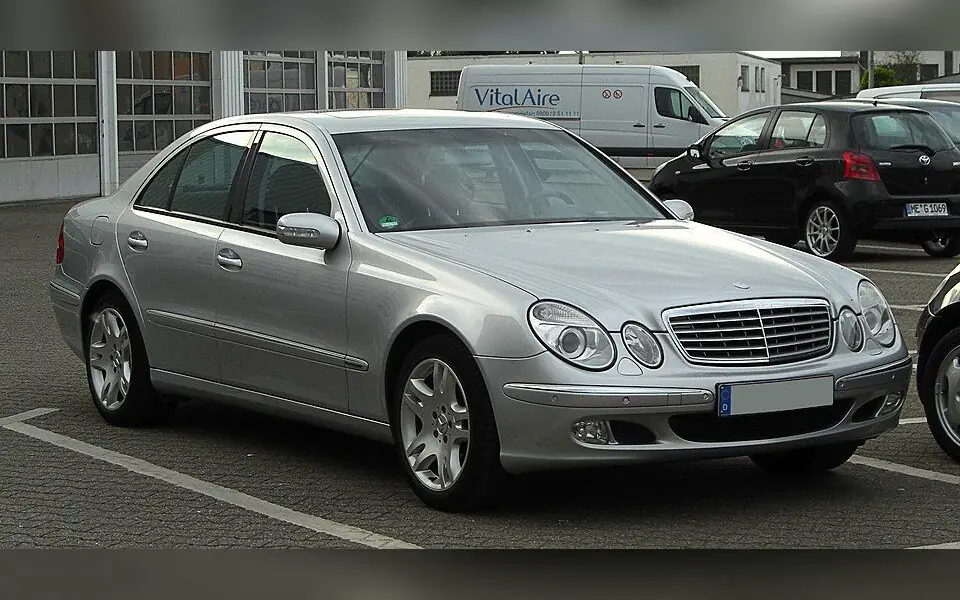
The essentials.
- 9 documented, sourced faults across its 6 engines.
- 4 of them depend on the equipment or the production date: ask what this car has.
- We have no official recalls on record for this model; ask anyway, with the chassis number (VIN).
- According to the data we have, the engine with the fewest documented faults is the E 55 AMG (M113K, 5.4 V8) (Petrol).
Typical faults by engine
The period and mileage are those mentioned by each sheet's sources. They are not a maintenance interval and do not predict that any particular car will fail.
All versions
Sheets the catalogue links to all 6 of its engines.
- 7G-Tronic conductor plateGearbox
- Period mentioned
- 2004 onwards (more failures in 2004–2008)
- Mileage mentioned
- The sheet does not mention a mileage.
Applies if: Only if fitted with 7G-Tronic. Confirm the gearbox type.
- AIRMATIC leaks and compressorSuspension
- Period mentioned
- 2002–2026
- Mileage mentioned
- 95,000–115,000 km
Applies if: Only if fitted with air suspension.
- Period mentioned
- 2002–2012
- Mileage mentioned
- The sheet does not mention a mileage.
Applies if: Only up to model year 2006; later W211s have conventional brakes. Confirm by VIN.
- 13-pin connector leak on the 722.6 gearboxAutomatic gearbox
- Period mentioned
- 1996–2013
- Mileage mentioned
- The sheet does not mention a mileage.
Applies if: Only if fitted with the automatic gearbox described in the record.
E 200 Kompressor (M271)
Petrol
- M271 chain and camshaft adjustersTiming system
- Period mentioned
- 2002–2015
- Mileage mentioned
- The sheet does not mention a mileage.
E 200 / 220 CDI (OM646)
Diesel
- OM646 injector seals (black death)Injection / intake
- Period mentioned
- 2002–2010
- Mileage mentioned
- From 150,000 km
E 280 / 320 CDI (OM642, desde 2005)
Diesel
- Oil cooler and injector leaksOil leaks / injectors
- Period mentioned
- 2005 onwards
- Mileage mentioned
- The sheet does not mention a mileage.
E 350 / 500
Petrol
- M272 / M273 balance shaft sprocketTiming system
- Period mentioned
- 2004–2008 (engines below serial number 2729..30 468993)
- Mileage mentioned
- The sheet does not mention a mileage.
E 55 AMG (M113K, 5.4 V8)
Petrol
We have no faults specific to this engine, only those common to every version.
E 63 AMG (M156, 6.2 V8)
Petrol
- AMG 6.2 (M156) head bolts and camshaftsEngine (cylinder head / valvetrain)
- Period mentioned
- 2006–2015
- Mileage mentioned
- The sheet does not mention a mileage.
Which engine has the fewest documented faults?
| Engine | Documented faults |
|---|---|
| E 200 Kompressor (M271)Petrol | 54 with conditions |
| E 200 / 220 CDI (OM646)Diesel | 54 with conditions |
| E 280 / 320 CDI (OM642, desde 2005)Diesel | 54 with conditions |
| E 350 / 500Petrol | 54 with conditions |
| E 55 AMG (M113K, 5.4 V8)PetrolFewest documented | 44 with conditions |
| E 63 AMG (M156, 6.2 V8)Petrol | 54 with conditions |
According to the data we have, the engine with the fewest documented faults is the E 55 AMG (M113K, 5.4 V8) (Petrol).
By fuel type, the one with the fewest documented faults is: Diesel.
We only count the sourced sheets we have. An engine with fewer is not guaranteed to be more reliable: it may have been studied less or sold in smaller numbers.
Official recalls: ask before you pay
We have no official recalls on record for this model. Our list is not complete: ask anyway, with the chassis number.
- Ask the seller for the chassis number (VIN): it has 17 characters, appears in the car's documents and can usually also be seen at the base of the windscreen.
- Ask an official Mercedes-Benz dealer, or the brand's official website if it lets you check by chassis number, whether each recall has been done or is still outstanding for that VIN.
- Manufacturer recalls are normally carried out free of charge by the official service network. If one is outstanding, ask for it to be done before you close the sale.
On the test drive: what to look and listen for
Taken from each sheet's symptoms and checks. You can tick off what you have already looked at: it is saved only in this browser.
0 of 9 checked
Timing system
Look out for: Rattle for 2–3 seconds or more on a cold start; engine light for camshaft timing deviation.
Ask them to check: Listen to a cold start, read timing fault codes and check the chain replacement history.
Look out for: Engine light with P0016 and P0017 (1200 and 1208 on Mercedes diagnostics), rattle on start-up, hesitation, misfires and, in severe cases, stalling.
Ask them to check: Compare the engine serial number with the 2729..30 468993 cut-off, read cam correlation codes and, if in doubt, inspect the sprocket with a borescope. First rule out the cam adjuster magnet (a cheap fault).
Injection / intake
Look out for: Puffing or “chuffing” at idle, a diesel smell under the engine cover and a hard black crust around the injectors; power loss from sooted intake flaps or turbo.
Ask them to check: Remove the engine cover and look for black residue around the injectors, listen at idle and check the intake flaps.
Oil leaks / injectors
Look out for: Oil pooling in the engine's V, burning oil smell, drips under the engine; or a hiss or chirp next to an injector with an exhaust smell.
Ask them to check: Visual inspection of the engine's V and the base of the injectors.
Engine (cylinder head / valvetrain)
Look out for: Coolant loss, coolant in the oil or white smoke (broken head bolts); rattle or ticking on start-up (camshaft and lifter wear).
Ask them to check: Overnight cooling system pressure test, oil analysis and camshaft inspection with a borescope.
Gearbox
Look out for: Gearbox stuck in 2nd or 3rd (limp mode), harsh shifts, delay engaging D or R, gearbox warning often without an engine light; turning off and restarting clears it for a while.
Ask them to check: Diagnose with Xentry/STAR to see the sub-codes (a basic reader only shows P0700). Check for oil in the gearbox connector.
Suspension
Look out for: One corner sags overnight, suspension fault warning, the compressor runs a lot or a compressor overheated message appears; eventually the car sits low and rides hard.
Ask them to check: Spray soapy water on bellows, lines and valve block; read each corner's data with Xentry; check the compressor fuse and relay. Do not replace the compressor without fixing the leak first, or the new one will fail soon.
Brakes
Look out for: Red messages in the cluster such as “STOP VEHICLE”, “Brake defective” or “Reduced braking power – visit workshop”, a hard pedal or little assistance, and pump noises when braking or opening the door. In a complete failure only the front wheels brake, using foot force alone.
Ask them to check: With any red brake warning, stop driving and call for assistance. At a Mercedes dealer: read the SBC control unit with official diagnostics, check open recalls and warranty extensions by VIN, and change the brake fluid only with the procedure SBC requires. The cycles-exhausted warning means replacing the unit, not clearing the code.
Automatic gearbox
Look out for: Oil around the electrical connector on the side of the gearbox, harsh shifts or slipping, delayed engagement and limp mode: the car stays in one gear (usually 2nd and reverse after a restart) and the engine light comes on.
Ask them to check: Read the gearbox control unit codes before switching off if possible (a restart can clear them). Look for oil at the connector and, with it unplugged, on its pins and at the control unit plug. According to the service bulletin, the connector should only be removed with gearbox oil below 50 °C to avoid damaging the conductor plate, and the harness must be routed without tension.
Sources
Every fact on this page comes from these Testigo sheets and their original sources. Sources are not checked in real time.
- M271 chain and camshaft adjusters
- OM646 injector seals (black death)
- Oil cooler and injector leaks
- M272 / M273 balance shaft sprocket
- AMG 6.2 (M156) head bolts and camshafts
- 7G-Tronic conductor plate
- AIRMATIC leaks and compressor
- SBC electro-hydraulic brake (Sensotronic)
- 13-pin connector leak on the 722.6 gearboxBrake & Front End (ALLDATA): oil leak at the 722.6 connectorMercedesMedic: replacing the 722.6 13-pin connectorMercedesMedic: P0715 and P0720 codes and limp modeMBClub UK (forum): oil in the 722.6 harness on an ML55Bob Is The Oil Guy (forum): CLK320 in limp modeThe Transmission Shop: leaks and limp mode in Mercedes gearboxes
More Mercedes-Benz buying guides
- Mercedes-Benz CLK (W209)2002–2009
- Mercedes-Benz SL (R230)2001–2012
- Mercedes-Benz CLS (C219)2004–2010
- Mercedes-Benz Vaneo (W414)2002–2005
- Mercedes-Benz Clase C (W203)2000–2007
- Mercedes-Benz SLK (R171)2004–2011
- Mercedes-Benz Clase A (W169)2004–2012
- Mercedes-Benz Clase B (W245)2005–2011