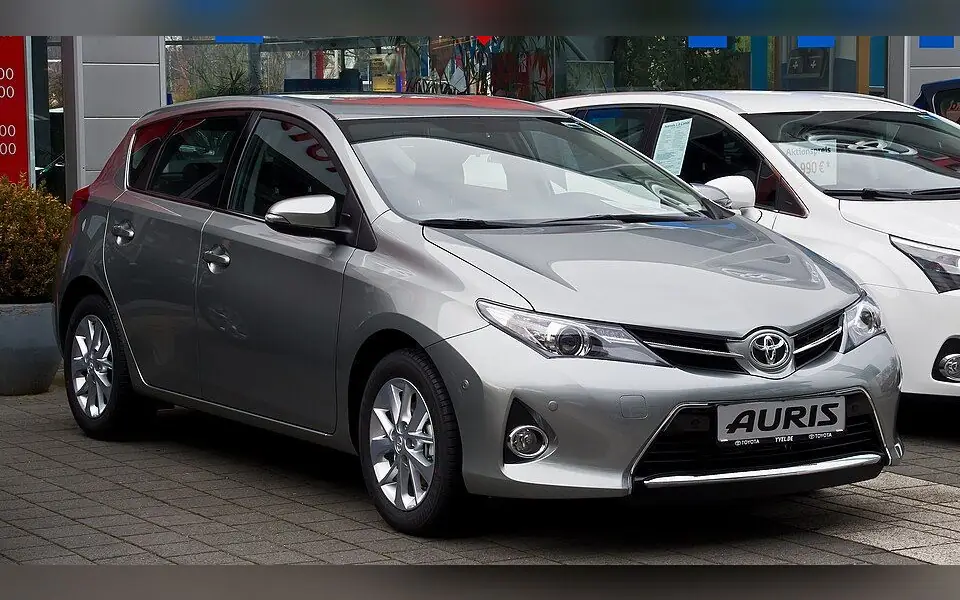
Before you buy a used Toyota Auris (II).
Taken only from Testigo's sourced sheets. Use it to question the seller and on the test drive: it does not confirm that any particular car is affected.
The essentials.
- 14 documented, sourced faults across its 4 engines.
- 5 of them depend on the equipment or the production date: ask what this car has.
- 5 official recalls on record: ask for the chassis number (VIN) and confirm they have been done.
- According to the data we have, the engines with the fewest documented faults are: 1.4 D-4D (Diesel), 1.6 / 2.0 D-4D (Diesel).
Typical faults by engine
The period and mileage are those mentioned by each sheet's sources. They are not a maintenance interval and do not predict that any particular car will fail.
All versions
Sheets the catalogue links to all 4 of its engines.
- Period mentioned
- 2012–2018
- Mileage mentioned
- The sheet does not mention a mileage.
- Toyota Auris (II): known faults of the chassis, steering and brakes according to L'argusSuspension and steering
- Period mentioned
- 2012–2018
- Mileage mentioned
- The sheet does not mention a mileage.
- Toyota Auris (II): known faults of the electronics and interior according to L'argusElectrical and electronic systems
- Period mentioned
- 2012–2018
- Mileage mentioned
- The sheet does not mention a mileage.
- Clutch, rear brakes and tail lights on the Auris IIKnown weak points
- Period mentioned
- 2012–2018
- Mileage mentioned
- The sheet does not mention a mileage.
Applies if: Weak points of this model from inspections, breakdown statistics and recalls; anything specific to one engine is stated in the sheet.
1.2 T / 1.33 / 1.6
Petrol
- Period mentioned
- 2015–2022
- Mileage mentioned
- The sheet does not mention a mileage.
- Period mentioned
- 2012–2018
- Mileage mentioned
- The sheet does not mention a mileage.
- Period mentioned
- Approx. 2008–2013
- Mileage mentioned
- What the sheet says: The oil level drops between services (more than half a litre per 1,000 km and up to a litre or more), usually from 150,000–200,000 km; bluish smoke.
Applies if: Only the 1.33 Dual VVT-i (1NR-FE).
1.8 Hybrid
Hybrid
- Period mentioned
- 2012–2018
- Mileage mentioned
- The sheet does not mention a mileage.
- Period mentioned
- Approx. 2010–2015
- Mileage mentioned
- The sheet does not mention a mileage.
Applies if: The documented cases are 2010–2015 cars.
- Clogged hybrid battery cooling fan and filterHigh-voltage battery
- Period mentioned
- 2003 onwards
- Mileage mentioned
- The sheet does not mention a mileage.
Applies if: The Toyota USA bulletin does not list this model, but its hybrid battery is also cooled with cabin air through a filter.
1.4 D-4D
Diesel
- Period mentioned
- Approx. 2001–2018
- Mileage mentioned
- The sheet does not mention a mileage.
- Period mentioned
- 2012–2018
- Mileage mentioned
- The sheet does not mention a mileage.
1.6 / 2.0 D-4D
Diesel
- Period mentioned
- 2012–2018
- Mileage mentioned
- The sheet does not mention a mileage.
- Period mentioned
- 2009–2018
- Mileage mentioned
- The sheet does not mention a mileage.
Applies if: Same 2.0 D-4D (1AD) and BMW-sourced 1.6 D-4D as the Verso and Avensis III; the guide and campaign cited cover those models: confirm by VIN.
Which engine has the fewest documented faults?
| Engine | Documented faults | Recalls |
|---|---|---|
| 1.2 T / 1.33 / 1.6Petrol | 72 with conditions | 5 |
| 1.8 HybridHybrid | 73 with conditions | 5 |
| 1.4 D-4DDieselFewest documented | 61 with conditions | 5 |
| 1.6 / 2.0 D-4DDieselFewest documented | 62 with conditions | 5 |
According to the data we have, the engines with the fewest documented faults are: 1.4 D-4D (Diesel), 1.6 / 2.0 D-4D (Diesel).
By fuel type, the ones with the fewest documented faults are: Petrol, Hybrid.
We only count the sourced sheets we have. An engine with fewer is not guaranteed to be more reliable: it may have been studied less or sold in smaller numbers.
Official recalls: ask before you pay
A recall existing does not mean this car is affected or that it is still outstanding: it depends on the chassis number, the market and the production date.
- Ask the seller for the chassis number (VIN): it has 17 characters, appears in the car's documents and can usually also be seen at the base of the windscreen.
- Ask an official Toyota dealer, or the brand's official website if it lets you check by chassis number, whether each recall has been done or is still outstanding for that VIN.
- Manufacturer recalls are normally carried out free of charge by the official service network. If one is outstanding, ask for it to be done before you close the sale.
Toyota airbag and seat-belt recalls (2003–2024)Airbags and seat belts
How to check it: Check by VIN whether any of the recalls is outstanding (at the dealer or on the DVSA website) and carry out the inspection or replacement it requires.
View full entryToyota fuel-system recalls (2002–2026)Fuel system
How to check it: Check by VIN whether any of the recalls is outstanding (at the dealer or on the DVSA website) and carry out the inspection or replacement it requires.
View full entryToyota electric and hybrid drive recalls (2012–2026)Electric powertrain
How to check it: Check by VIN whether any of the recalls is outstanding (at the dealer or on the DVSA website) and carry out the inspection or replacement it requires.
View full entryToyota engine, transmission and software recalls (2002–2026)Powertrain and engine management
How to check it: Check by VIN whether any of the recalls is outstanding (at the dealer or on the DVSA website) and carry out the inspection or replacement it requires.
View full entryToyota electrical, lighting and electronics recalls (2004–2025)Electrical and electronic systems
How to check it: Check by VIN whether any of the recalls is outstanding (at the dealer or on the DVSA website) and carry out the inspection or replacement it requires.
View full entryOn the test drive: what to look and listen for
Taken from each sheet's symptoms and checks. You can tick off what you have already looked at: it is saved only in this browser.
0 of 14 checked
Engine
Look out for: Poor acceleration and strong jerking, misfires and limp mode; at high mileage, loss of power and higher consumption from carbon on injectors, valves and intake.
Ask them to check: Read misfire codes and check the coil date; ask for a goodwill replacement; clean the intake if there are deposits.
Look out for: Engine scraping noise (up to 07/11/2013); Timing chain noise when cold; [1.2 T] Loss of power and engine hesitation
Ask them to check: Compare your symptom and your car's build date with this list. If they match, tell the workshop and ask them to check that part first before replacing others. The brand or a warranty extension covers some repairs: ask the dealer with the car's details.
Look out for: Excessive oil consumption in heavy city use (up to 07/11/2013); Battery overheating (heavy city use) (up to March 2014)
Ask them to check: Compare your symptom and your car's build date with this list. If they match, tell the workshop and ask them to check that part first before replacing others. The brand or a warranty extension covers some repairs: ask the dealer with the car's details.
Look out for: Noisy accessory belt; Engine warning light on (up to July 2014); Oil level rises and the particulate filter clogs; Engine warning light on (up to May 2018); Abnormal oil consumption (over 0.5 l per 1,000 km) until the end of production; [1.4 D-4D/2.0 D-4D] Loss of power (up to March 2015 on the 2.0 or May 2015 on the 1.4); Oil leak (up to February 2016)
Ask them to check: Compare your symptom and your car's build date with this list. If they match, tell the workshop and ask them to check that part first before replacing others. The brand or a warranty extension covers some repairs: ask the dealer with the car's details.
Look out for: Loss of power; Engine noise; [2.0 D-4D (Toyota)] Engine knocking; [2.0 D-4D (Toyota)] Excessive oil consumption (up to chassis SB1ZF3JE30E006125); [1.4 D-4D/2.0 D-4D] Loss of power (up to March 2015 on the 2.0 or May 2015 on the 1.4)
Ask them to check: Compare your symptom and your car's build date with this list. If they match, tell the workshop and ask them to check that part first before replacing others. The brand or a warranty extension covers some repairs: ask the dealer with the car's details.
Look out for: The oil level drops between services (more than half a litre per 1,000 km and up to a litre or more), usually from 150,000–200,000 km; bluish smoke.
Ask them to check: Check the history for oil top-ups or replaced pistons; measure consumption between two changes and check the spark plugs.
Look out for: Knocking or rattling on cold start, misfires (P0301–P0304), coolant loss and, eventually, a damaged head gasket.
Ask them to check: Read the misfire codes, watch the coolant level and clean the EGR cooler, valve and manifold preventively; if coolant is lost with no visible leak, run a combustion-gas test.
Look out for: Coolant loss, overheating or white smoke (gasket or head); on the 1.6 D-4D, hesitation, loss of power or the engine stopping.
Ask them to check: Combustion-gas test on the coolant and check oil consumption; ask Toyota by VIN whether the campaign was done. On the 1.6 D-4D, check the EGR recall.
Gearbox
Look out for: 6-speed manual gearbox noise (up to 01/09/2013); Clutch squeak on the 1.6 VVT-i (up to March 2014); Hard to engage 1st (6-speed manual)
Ask them to check: Compare your symptom and your car's build date with this list. If they match, tell the workshop and ask them to check that part first before replacing others. The brand or a warranty extension covers some repairs: ask the dealer with the car's details.
Suspension and steering
Look out for: Knocks from the front axle (up to February 2015); Rear axle noise (up to October 2016)
Ask them to check: Compare your symptom and your car's build date with this list. If they match, tell the workshop and ask them to check that part first before replacing others. The brand or a warranty extension covers some repairs: ask the dealer with the car's details.
Electrical and electronic systems
Look out for: Ignition key hard to turn (up to 22/01/2016)
Ask them to check: Compare your symptom and your car's build date with this list. If they match, tell the workshop and ask them to check that part first before replacing others. The brand or a warranty extension covers some repairs: ask the dealer with the car's details.
Injection / turbo
Look out for: Hard starting, rough idle, smoke and loss of power; noise or vibration from the flywheel when starting and releasing the clutch; oil consumption.
Ask them to check: Read the codes, run an injector back-leak test and check the EGR. Listen to the flywheel at idle with the clutch released. Measure oil consumption.
Known weak points
Look out for: A manual clutch that wears quickly, rear discs rusted by little use of the rear brake and tail lights with water droplets; on hybrids, the battery and voltage converter should be checked before buying.
Ask them to check: Test the clutch; check rear discs and tail lights; on hybrids, read the battery condition.
High-voltage battery
Look out for: Hybrid battery cooling maintenance message, warning light with codes P0A80 or P0A7F, a noisy fan and less electric assistance; if ignored, the battery ages faster.
Ask them to check: Clean or replace the filter and clean the fan before condemning the battery; keep the intake grille clear. At the garage, read the codes and, if needed, install the software Toyota specifies.
Sources
Every fact on this page comes from these Testigo sheets and their original sources. Sources are not checked in real time.
- Ignition coils and carbon on the 1.2 turbo (8NR-FTS)
- Toyota Auris (II) 1.2 T / 1.33 / 1.6: known faults of the engine according to L'argus
- Toyota Auris (II): known faults of the gearbox and transmission according to L'argus
- Toyota Auris (II): known faults of the chassis, steering and brakes according to L'argus
- Toyota Auris (II): known faults of the electronics and interior according to L'argus
- Toyota Auris (II) 1.8 Hybrid: known faults of the engine according to L'argus
- Injectors, dual-mass flywheel and oil consumption on the 1.4 D-4D (1ND-TV)
- Toyota Auris (II) 1.4 D-4D: known faults of the engine according to L'argus
- Toyota Auris (II) 1.6 / 2.0 D-4D: known faults of the engine according to L'argus
- Oil consumption on the 1.33 Dual VVT-i (1NR-FE)
- Clutch, rear brakes and tail lights on the Auris II
- Clogged EGR and head gasket on the 1.8 hybrid (2ZR-FXE)
- Clogged hybrid battery cooling fan and filter
- Head gasket, cracks and EGR on the Verso and Avensis III diesels
- Toyota airbag and seat-belt recalls (2003–2024)
- Toyota fuel-system recalls (2002–2026)
- Toyota electric and hybrid drive recalls (2012–2026)
- Toyota engine, transmission and software recalls (2002–2026)
- Toyota electrical, lighting and electronics recalls (2004–2025)
More Toyota buying guides
- Toyota Yaris (III)2011–2020
- Toyota RAV4 (IV)2013–2018
- Toyota Land Cruiser V8 (J200)2008–2021
- Toyota Proace (I)2013–2016
- Toyota Avensis (III)2009–2018
- Toyota Verso2009–2018
- Toyota Verso-S2011–2016
- Toyota Prius+2012–2021